Agentic AI Multi-Agent Orchestration: Safe Proven 2025 Guide
Meta description: Agentic AI multi-agent orchestration in 2025: how agent teams plan, use tools, stay governed, and ship reliable enterprise workflows.
Agentic AI multi-agent orchestration is moving from demos to real work. In 2025, teams want agents that can plan steps, use tools, and hand off tasks without breaking rules.
This guide explains agentic AI multi-agent orchestration in a practical way. You’ll learn what agentic AI is, how multi-agent orchestration works, and how to deploy it with control. For systems that also need memory and permissions, see context-aware AI for business.
Table of Contents
- What is Agentic AI?
- Understanding Multi-Agent Orchestration
- Where Agentic AI Works Best in 2025
- Agentic AI Multi-Agent Orchestration Frameworks
- Design Patterns That Hold Up in Production
- Common Pitfalls and How Teams Avoid Them
- FAQ
- Conclusion

What is Agentic AI?
Agentic AI is an AI system that can take steps toward a goal. It does more than answer questions. It can plan actions, call tools, and track progress.
In practice, agentic AI follows a loop: plan, act, check results, then adjust. This is why agentic AI multi-agent orchestration is useful for real workflows.
What makes an AI “agentic”
- Goal-driven behavior: it tries to complete an outcome, not just respond.
- Tool use: it can call APIs, fetch docs, draft content, or create tickets.
- State tracking: it remembers what it has done in the task.
- Rules: it follows limits on what it can read and what it can change.
Understanding Multi-Agent Orchestration
Multi-agent orchestration coordinates several agents to complete a larger task. Each agent has a role, a tool set, and clear limits.
This approach works well when one agent would otherwise need to research, draft, verify, and execute. With agentic AI multi-agent orchestration, you can split those steps and keep control.
Why teams use multiple agents
- Role separation: one drafts, one checks, one executes.
- Safer access: only the executor agent can write to systems of record.
- Better quality: a reviewer agent can catch mistakes before output ships.
- Clearer logs: you can trace who did what and why.
Where Agentic AI Works Best in 2025
Agentic AI multi-agent orchestration works best when tasks have clear steps and a clear “done” state. It struggles when goals are vague.
Strong use cases
- Customer support help: summarize a case, pull policy, draft a reply for approval.
- Sales ops: create account briefs and next-step drafts using CRM context.
- IT operations: collect signals, draft runbooks, and prepare incident notes.
- Compliance work: gather evidence, flag gaps, and draft audit notes for review.
Use cases to delay
- High-stakes actions without review: pricing, payments, deleting data.
- Unbounded tool access: “do anything” agents are hard to trust.
- Open-ended strategy work: too much ambiguity, too little ground truth.
Agentic AI Multi-Agent Orchestration Frameworks
Framework choice matters less than safe design. Still, a solid reference for tool-based agents is the OpenAI Agents SDK documentation.
OpenAI Agents SDK documentation
When you evaluate tools for agentic AI multi-agent orchestration, look for: role definitions, tool permission controls, tracing, and easy testing.
Design Patterns That Hold Up in Production
Keep the toolbox small
Reliable agents use a short list of tools. Fewer tools mean fewer surprise paths. This also makes audits easier.
Put approvals on write actions
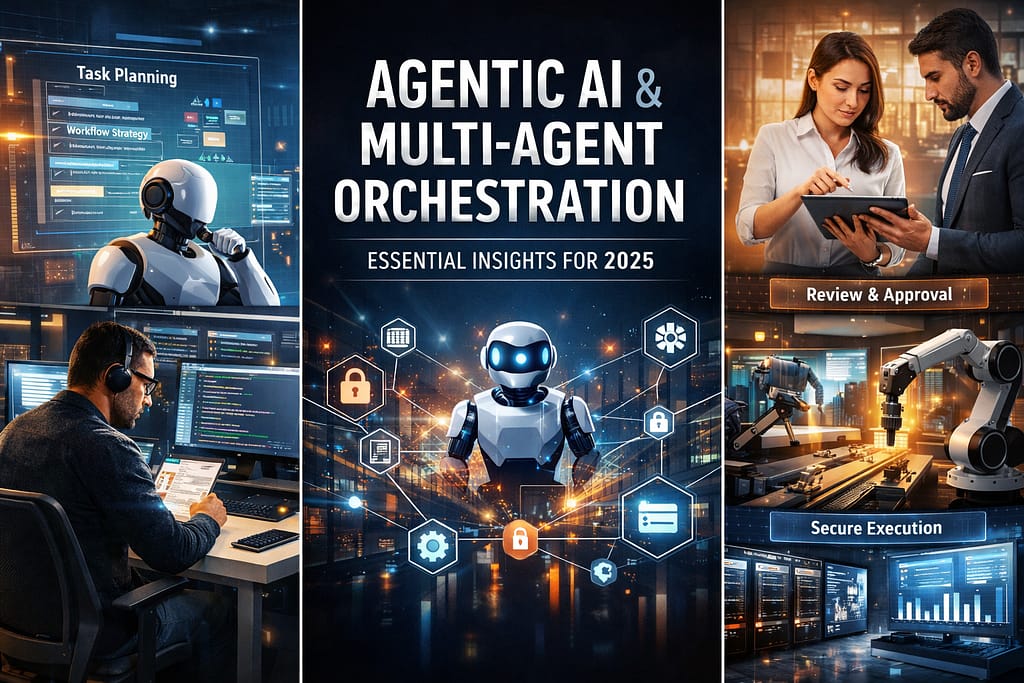
Drafting is low risk. Writing to a system of record is not. A strong pattern is: draft, review, then execute.
Make context explicit
Agents do better when context is clear. That includes user role, allowed sources, and the workflow stage. This is a core part of agentic AI multi-agent orchestration.
Enforce permissions before retrieval
Access control must happen before the system fetches data. If a user cannot see a document, the agent should not retrieve it.
Common Pitfalls and How Teams Avoid Them
Too much autonomy too soon
Start with drafts and approvals. Move to execution only after logs show stable behavior over time.
No test set
Without test cases, quality becomes opinion. Build a small set of real tasks and rerun it after every change.
Unclear ownership
Decide who owns prompts, tools, policies, and release gates. Multi-agent systems add moving parts, so ownership must be clear.
FAQ
What is the main benefit of agentic AI?
It reduces repeated work by handling multi-step tasks and producing drafts that humans can approve.
How do multi-agent systems differ from single-agent setups?
They split roles. One agent can draft, another can verify, and another can execute. This improves control and clarity.
How do I keep agentic AI safe?
Limit tools, enforce permissions before retrieval, require approval for write actions, and keep detailed logs.
Conclusion
Agentic AI multi-agent orchestration works best when it is structured. Clear roles, limited tools, and approval gates create systems teams can trust.
If your workflows need memory and permissions, pair this approach with a context-aware architecture: context-aware AI for business.
Explore more in AI, GenAI, and Data Science, or Stay Connected.