
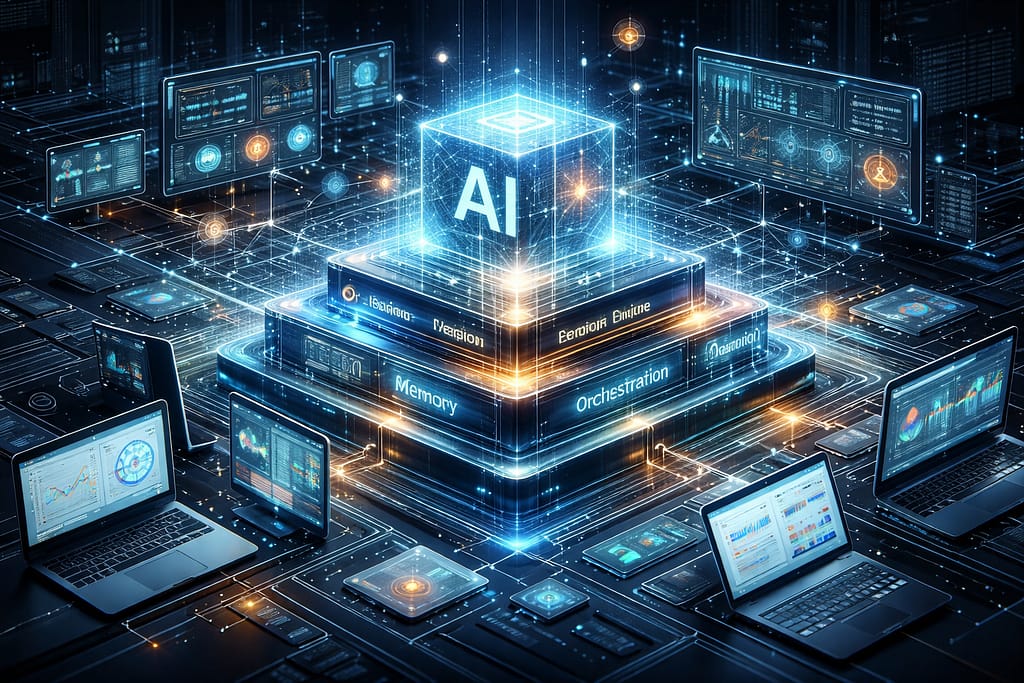
AI-native architecture is not a feature upgrade. It is a structural shift. Many SaaS products still treat AI as an add-on. They bolt a chatbot onto an existing workflow and call it innovation.
This approach already shows its limits. The product feels slow. Outputs are inconsistent. Costs grow fast. Teams spend more time managing prompts than improving outcomes.
The core issue is simple. Adding AI to SaaS assumes the old architecture is still valid. It is not. AI changes how software reasons, decides, and adapts.
This article explains why AI-native architecture makes “adding AI to SaaS” obsolete. It also explains what changes when AI becomes the system, not the feature.
What AI-Native Architecture Really Means
AI-native architecture means AI is the default execution layer. The system is designed around inference, memory, and decision loops from day one.
In AI-native systems:
- AI decides how workflows progress
- State and memory are first-class components
- Rules are evaluated dynamically, not hard-coded
- Human input is supervisory, not procedural
This is different from “AI-powered SaaS.” In those systems, AI reacts after the workflow runs. In AI-native systems, AI drives the workflow itself.
Why Adding AI to SaaS Breaks Down
Traditional SaaS platforms were built around fixed flows. Forms lead to rules. Rules trigger actions. This works when logic is predictable.
AI introduces uncertainty. Outputs vary. Decisions depend on context. Fixed flows struggle to adapt.
When teams bolt AI onto SaaS, several problems appear:
- AI runs outside the core transaction flow
- State is duplicated or lost
- Costs scale with retries and corrections
- Governance becomes unclear
These systems feel fragile. They require constant human cleanup. They do not improve with use.

Core Differences: AI-Native vs AI-Added Systems
The difference is architectural, not cosmetic.
- AI-added SaaS: deterministic core, probabilistic edges
- AI-native architecture: probabilistic core with controlled boundaries
In AI-native systems, uncertainty is expected. The system tracks confidence. It escalates when needed. It learns over time.
This is why AI-native platforms age better. They do not fight AI behavior. They are built around it.
AI-Native Architecture in Practice
AI-native systems share several traits.
Decision-Centered Design
Workflows are driven by decisions, not screens. Each step evaluates context before moving forward.
Explicit State and Memory
State is stored outside the model. Memory is scoped and typed. Nothing relies on prompt history alone.
Continuous Evaluation
Every output is measured. Feedback loops exist. The system improves without manual rewrites.
These traits align closely with agent-based systems. If you are exploring that path, see Agentic AI Is Not Plug-and-Play.
Governance and Risk in AI-Native Systems
AI-native does not mean uncontrolled. In fact, control improves.
Because decisions are explicit, governance is easier. Policies are enforced at decision points. Logs show why actions happened.
Many teams align their controls with the NIST AI Risk Management Framework. It maps well to AI-native design.
For implementation guidance, the OpenAI Agents documentation shows how decision loops, tools, and supervision work together.
When AI-Native Architecture Is Required
You do not need AI-native design for every product. You need it when:
- Decisions depend on changing context
- Workflows span multiple systems
- Human review is selective, not constant
- Rules evolve faster than code releases
If your product relies on static flows, AI add-ons may suffice. If your product relies on judgment, AI-native architecture becomes necessary.
Frequently Asked Questions
Is AI-native architecture the same as using LLMs?
No. LLMs are components. AI-native architecture is how the system is organized.
Can existing SaaS products become AI-native?
Some can, but it requires deep refactoring. Most will hybridize first.
Does AI-native increase risk?
No. Poorly designed AI increases risk. AI-native systems make decisions visible and auditable.
Is AI-native only for large enterprises?
No. Smaller teams benefit first because AI-native reduces manual work.
Conclusion
AI-native architecture makes “adding AI to SaaS” obsolete because intelligence is no longer optional. It is foundational.
Systems built for deterministic flows cannot keep up with probabilistic reasoning. Systems built around AI can.
Explore more writing in AI and GenAI, or Stay Connected.